Project Pacific Inland proposes a 200-mile seawater pipeline from an offshore intake near the Port of Long Beach to a nuclear-powered desalination campus in Primm, Nevada, delivering Pacific Ocean water to Southern Nevada entirely outside the Colorado River system.
Project Pacific Inland addresses the Colorado River water crisis with new infrastructure built where California’s regulatory framework cannot reach it.
A pipeline from an offshore subsea intake near the Port of Long Beach, along I-710, I-10, and I-15, to a processing campus at Primm, Nevada.
NuScale VOYGR-6 Small Modular Reactors (6 × 77 MWe, NRC-approved May 2025) power the campus at 95% capacity factor, year-round, without fossil fuels or intermittency.
The campus co-produces potable water, green hydrogen and ammonia, critical minerals from the brine stream using zero-waste ZLD design, and grid-scale energy storage from the Lucy Gray Mountains.
The desalination plant is in Nevada. Only the offshore intake requires a California permit. The California Coastal Commission has no authority over Primm.
The river that supplies water to 40 million people and 5 million acres of farmland is structurally over-allocated. It has been for a century. The crisis is not a drought. It is a permanent arithmetic problem.
The Colorado River Compact of 1922 allocated water based on an unusually wet period. The actual historical average flow is 14.6 million acre-feet per year. Total allocations exceed 16.5 million acre-feet. The system has been over-allocated since it was designed. Decades of drought have turned a slow-building problem into an active crisis. Lake Mead slipped below 1,050 feet in early June 2026, and Bureau of Reclamation projections place its most probable elevation at 1,020 feet by July 2027 — more than 20 feet below the 2022 record low.
Recent CoverageUniversity of Colorado researchers warn the reservoir system faces potential collapse within years. A 2.6 million acre-foot annual shortfall between supply and use means reservoir levels continue falling even with conservation.
Read ArticleBureau of Reclamation projects Lake Mead could reach 1,020 feet by July 2027 — 20 feet below the 2022 record low. At 1,035 feet, only five of Hoover Dam’s 17 turbines can generate power.
Read ArticleFederal forecasters predict Lake Mead will drop more than 20 feet below its 2022 record low within two years, driven by a historically poor snowpack and expiring operating agreements.
Read ArticleThe Bureau of Reclamation’s 24-month study projects Lake Mead could reach a record low of 1,036 feet in 2026. Water rights were established during an anomalously wet period — the river has never produced what was allocated.
Read ArticleIn 2022, the California Coastal Commission unanimously rejected Poseidon Water’s Huntington Beach desalination plant after 22 years of permitting attempts and $1.4 billion in development investment. Governor Newsom called the rejection a “big mistake.” The Commission voted 12-0 against him.
The Huntington Beach rejection was not an anomaly. It was a demonstration of the structural barrier facing any large coastal desalination project in California. The California Coastal Commission has broad authority over any facility that touches the coast, uses ocean water, or affects coastal habitat. That authority has terminated multiple large desalination proposals and sets a prohibitively high bar for any future coastal plant.
Project Pacific Inland was designed from the ground up to avoid this barrier. The desalination campus would be located in Primm, Nevada. The pipeline runs through Nevada and California inland corridors. The only component subject to Coastal Commission review is the offshore intake, which is positioned in the legacy Wilmington Oil Field zone, where subsea industrial infrastructure has been continuously reviewed and authorized for more than 70 years.
The Huntington Beach RejectionDespite worsening drought and Governor Newsom’s support, commissioners voted unanimously against the $1.4 billion plant. The decision sent the message that coastal desalination faces major structural hurdles in California.
Read ArticleThe unanimous decision sealed the project’s fate and set a high bar for future coastal desalination. The commission cited harm to marine life, cost impacts, and sea-level rise risk.
Read ArticleTwenty years of permitting ended with a unanimous vote. Audience members stood and cheered. The plant would have returned half of its 100 million daily gallons as concentrated brine to the ocean.
Read Article“Project Pacific Inland plans to site its processing campus in Primm, Nevada specifically to eliminate the California Coastal Commission barrier that ended the Huntington Beach project. Only the offshore intake falls under Coastal Commission review, and it is positioned in a legacy industrial marine zone with 70 years of regulatory precedent. The intake design is non-traditional, modular, expandable, and designed to be shared with California if they ever need to tap into it for future California based desalination projects. The pipeline itself is also designed to be shared in the instance that California wants to tap into it.”
A New Water Supply for the American West. From the Pacific Ocean to Southern Nevada.
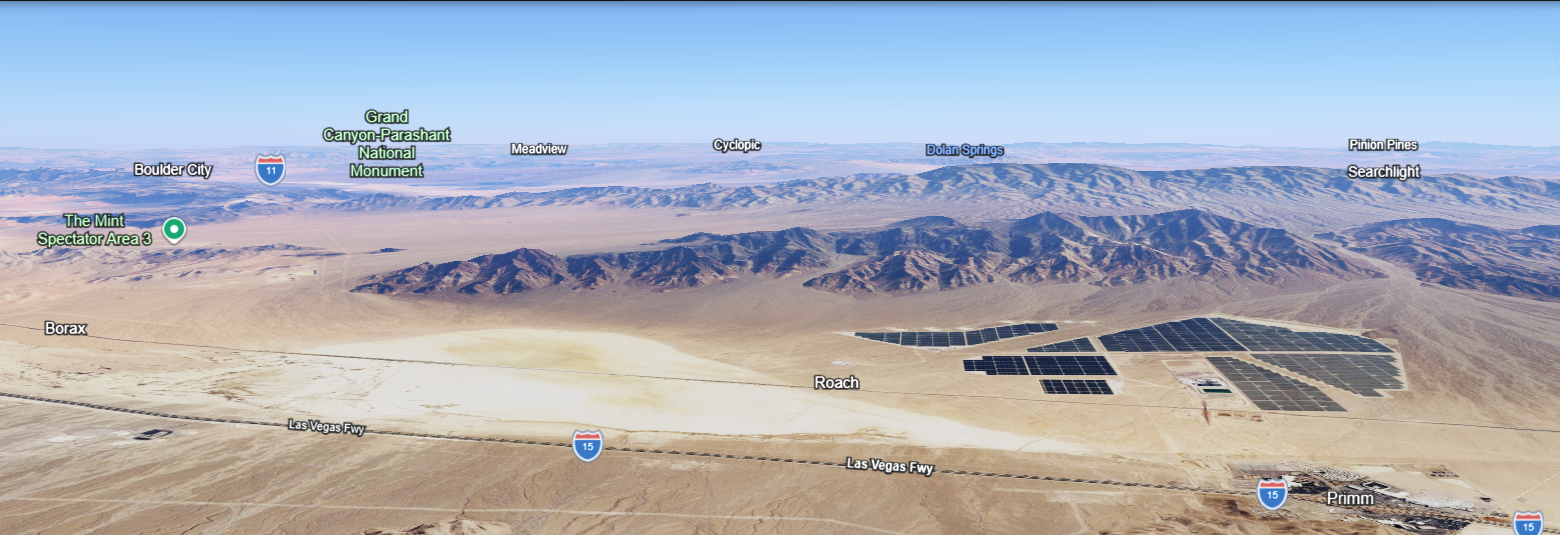
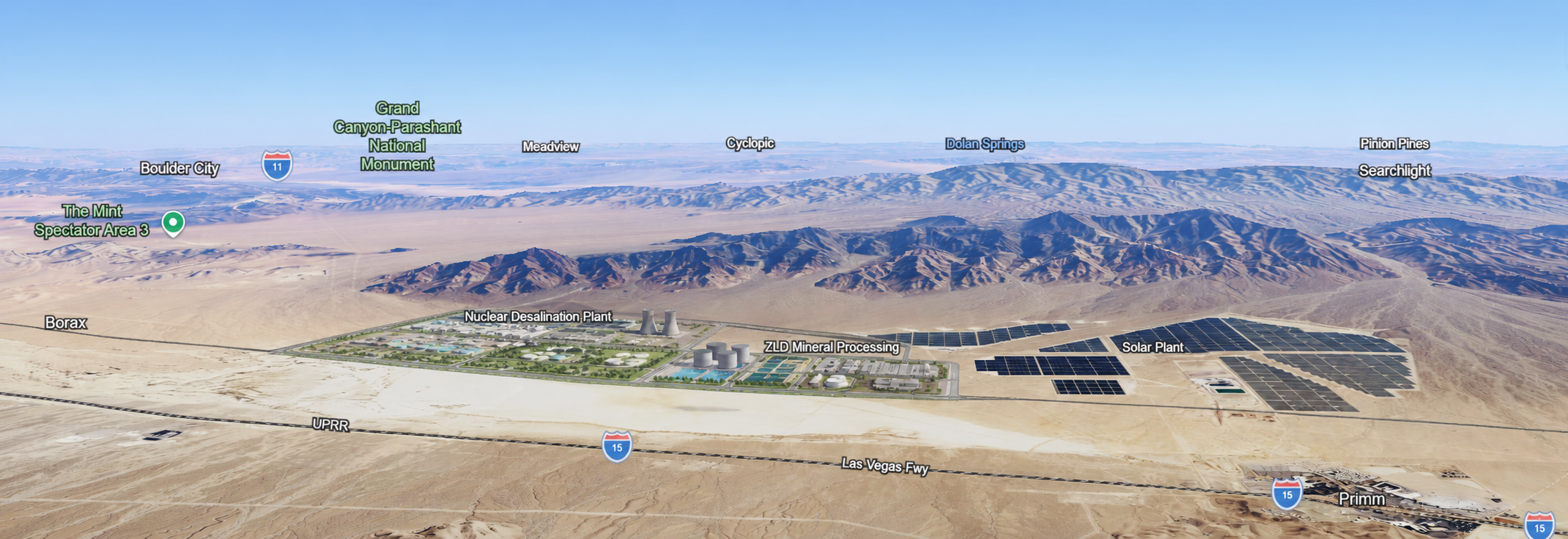
Drag to compare the existing site to the proposed campus concept plan. (Note: Concept plan is illustrative and subject to change)
90 to 150 individual intake wells on a shared manifold, positioned within the legacy Wilmington Oil Field production zone approximately one mile from the Port of Long Beach. Legacy zone siting provides 70 years of regulatory precedent, comprehensive subsurface records, and reduced environmental opposition compared to undocumented offshore areas.
72-inch diameter, API 5L Grade X52–X60 high-strength steel pipeline running via I-710, I-10, and I-15 from the Port of Long Beach to Primm, Nevada. Pumping stations connect to the California SCE grid as commercial industrial customers; the nuclear campus sells surplus power to NV Energy and CAISO independently. Pelton turbines on the Cajon Pass descent provide pressure control and recover approximately 10.9 MW per pipe. The inland routing avoids coastal habitat and removes the facility from California Coastal Commission jurisdiction over the onshore plant.
NuScale Small Modular Reactor campus at Primm, Nevada (35.645°N, 115.330°W). Phase 1: one VOYGR-6 building — 6 × 77 MWe modules = 462 MWe, NRC design-approved May 2025. Phase 2: a second VOYGR-6 building adds 462 MWe (924 MWe cumulative). Phase 3: a third VOYGR-6 building brings the baseline to 1,386 MWe across 18 modules; if the VOYGR-12 configuration (12 × 77 MWe = 924 MWe) receives NRC approval before Phase 3 construction, Building 3 can be upgraded to reach 1,848 MWe across 24 modules. Every module across all buildings is the identical certified 77 MWe NuScale Power Module — the only Small Modular Reactor with NRC design approval in the United States. Phase 4 (optional): a fourth building if demand conditions warrant.
Seawater reverse osmosis desalination at Phase 1 scale of 57 million gallons per day (the minimum self-cleaning velocity in a 72-inch pipeline sets this floor), scaling to 500 MGD at Phase 3. Zero-liquid-discharge (ZLD) mineral recovery converts every dissolved mineral in the brine into a commercial product: sodium chloride to chlor-alkali plants, magnesium chloride for dust suppression and de-icing markets, potassium sulfate for fertilizer, bromine for specialty chemicals, and calcium sulfate for construction materials. All residual streams are routed to CalPortland’s Oro Grande cement plant (65 miles, Union Pacific rail access) as alternative raw materials. True zero solid waste design.
Gravitational mountain rail storage (ARES North America technology) and pumped hydro storage using the 1,654-foot elevation head of the Lucy Gray Mountains in Clark County, Nevada. Primary purpose: operational resilience during planned desalination plant or pipeline maintenance outages, ensuring the nuclear campus continues at full output and power is stored rather than curtailed. Secondary purpose: grid arbitrage revenue during normal operations. Grid-scale storage supporting campus operations and NV Energy interconnection.
Target commissioning: ~2038
Target commissioning: ~2044
Target commissioning: ~2050
At Phase 3, Project Pacific Inland removes 560,000 acre-feet per year of demand from the Colorado River system. Lake Mead’s equilibrium elevation rises by approximately 5 to 6 feet above where it would otherwise be — a permanent shift as long as the project operates. Hoover Dam recovers generating capacity. Arizona’s Central Arizona Project faces fewer shortage cuts. Mexico’s 1944 Water Treaty delivery obligation becomes easier to meet.
The Bureau of Reclamation earns an estimated $31.5 million per year in additional Hoover Dam power revenue at Phase 3, giving the federal government a direct financial interest in the project’s success.
In May 2026, the SNWA board approved a memorandum of understanding to negotiate a water transfer arrangement with the San Diego County Water Authority, linked to the Carlsbad Desalination Plant. That arrangement is capped at 56,000 to 62,000 acre-feet per year, depends on California’s ongoing cooperation, and represents a paper transfer of existing supply rather than new infrastructure.
Project Pacific Inland plans to deliver 560,000 acre-feet per year at Phase 3 from new infrastructure Nevada controls — ten times the scale of the Carlsbad arrangement, without California dependency.
Allen Kafchinski
Managing Member, Pacific Inland Water Resources LLC
Allen Kafchinski is the concept originator and Managing Member of Pacific Inland Water Resources LLC. He is a 24-year mechanical professional, currently a fleet mechanic with a background in power generation infrastructure and self-taught programming spanning 15 years.
His power generation experience began at Hamakua Energy Partners on the Big Island of Hawaii, a 60MW combined cycle facility, where his father who served as General Manager overseeing the plant’s construction and operations would let him assist with major operations such as steam turbine and combustion turbine rebuilds. He later served as an instrumentation and tubing technician for a mechanical engineering internship at the Power Systems Development Facility at the National Carbon Capture Center in Wilsonville, Alabama, during active clean energy research operations in 2011.
Project Pacific Inland is the product of more than a year of full-time development work completed outside of regular employment hours. The project’s 1,900-paragraph technical whitepaper, phased financial model, development plan, action guide, and business plan were developed from scratch by Kafchinski, drawing on his mechanical systems expertise and infrastructure knowledge.
Pacific Inland Water Resources LLC is a Nevada limited liability company. Allen Kafchinski is the Managing Member.
“The same instinct that drives a mechanic to be addicted to solving problems is what built this project. The Colorado River system has a known failure mode. The fix requires new infrastructure, not more conservation. This is that infrastructure.”
The executive brief, technical whitepaper, and financial model are available to institutional partners, government agencies, and potential development partners upon request.